


Prediction markets are often promoted as a revolutionary tool for forecasting the future. By allowing participants to buy and sell shares tied to real-world outcomes, platforms such as Polymarket claim to harness collective intelligence more effectively than traditional polling or expert analysis.
But what happens when the outcome itself becomes controversial?
A recently disputed Polymarket market concerning whether U.S. forces would enter Iran has reignited concerns about the integrity of prediction market resolutions and the power wielded by oracle systems that ultimately decide winners and losers.
The Market
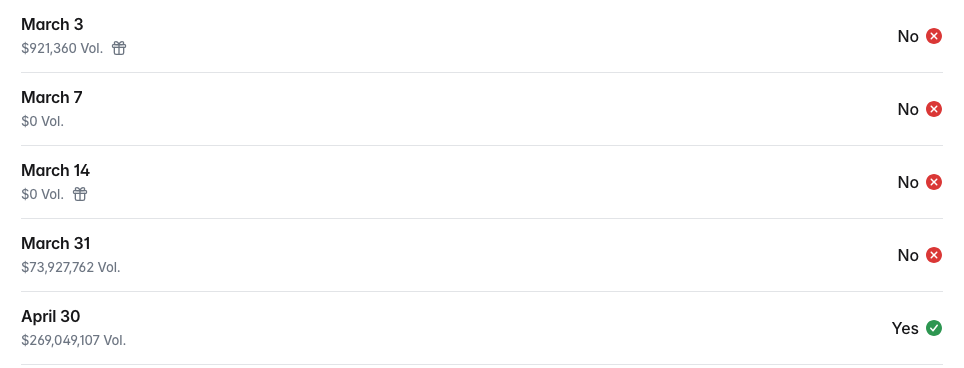
The market series, titled “US forces enter Iran by…?”, offered traders multiple deadlines, including March 1, March 3, March 7, March 14, March 31, April 30, and December 31.
According to screenshots reviewed by Truthlytics:
- The March contracts resolved “No.”
- The March 31 contract resolved “No.”
- The April 30 contract resolved “Yes.”
- The December 31 contract also resolved “Yes.”
The April 30 contract reportedly generated more than $269 million in trading volume.
For many traders, the result was surprising.
The Central Question
The controversy centers on a simple question:
What specific event caused Polymarket to determine that U.S. forces entered Iran before April 30?
Publicly available reporting from the period did not document a large-scale U.S. ground invasion, occupation, or openly acknowledged military entry into Iranian territory.
As a result, some traders who held “No” positions argue that the market outcome contradicts the common understanding of events.
One trader who lost money on the market described the result as evidence of a broader “resolver scam” problem, a term increasingly used by critics of decentralized prediction markets.
Reality Versus Resolution
At the heart of the dispute is a distinction many newcomers fail to appreciate.
Prediction markets are not always settled based on what participants believe happened. Instead, they are settled according to the specific wording of the contract and the interpretation of the platform’s resolution mechanism.
In other words:
Reality matters.
But contract interpretation often matters more.
If a market asks whether “U.S. forces enter Iran,” a resolver may evaluate the question differently than traders who interpreted it as “the United States launches an invasion of Iran.”
That difference can determine the transfer of millions of dollars.
The Oracle Problem
Polymarket relies on external resolution systems to determine outcomes.
While blockchain technology can securely record transactions, it cannot independently verify real-world events. Human judgment must ultimately enter the process.
Critics argue that this creates a fundamental vulnerability.
If a market’s wording is ambiguous, the final outcome may depend less on observable reality and more on how a small group of decision-makers interprets the rules.
Supporters of prediction markets counter that every forecasting system requires a final arbiter and that disputes are inevitable when dealing with complex geopolitical events.
Why Traders Are Concerned
Several aspects of the Iran market have attracted scrutiny:
Ambiguous Language
The phrase “U.S. forces enter Iran” is broad.
It could refer to:
- A full-scale invasion.
- A limited military incursion.
- Special operations activity.
- Intelligence-linked military presence.
- Temporary deployment on Iranian territory.
Without precise definitions, participants may be betting on entirely different interpretations.
Massive Financial Stakes
With hundreds of millions of dollars reportedly traded, even a controversial interpretation can result in enormous wealth transfers between market participants.
Limited Transparency
Many traders claim they were unaware that outcome interpretation could become as important as the underlying event itself.
The Broader Pattern
The Iran market is not the first prediction market to face criticism.
Over the past several years, prediction markets have repeatedly encountered disputes involving:
- Elections.
- Military conflicts.
- Court rulings.
- Corporate mergers.
- Government actions.
In many cases, controversy emerges not because the event itself is unclear but because the contract language leaves room for competing interpretations.
Was the Resolution Wrong?
At present, there is insufficient publicly available evidence to conclusively determine whether the April 30 resolution was incorrect.
To evaluate the outcome, investigators would need:
- The complete market rules.
- The official resolution explanation.
- The evidence relied upon by the resolver.
- Any dispute records or appeals.
Without those materials, accusations of fraud remain allegations rather than proven facts.
However, the controversy highlights a deeper issue facing prediction markets.
The Trust Challenge
Prediction markets promise to create incentives for truth-seeking.
Yet when participants lose confidence in the resolution process, the market’s credibility can suffer regardless of whether the official outcome was technically correct.
For traders, the lesson may be simple:
Before betting on whether an event will occur, it is essential to understand who ultimately decides whether it occurred.
In the case of the Iran market, that distinction may have been worth hundreds of millions of dollars.
Until greater transparency is provided regarding the basis for the April 30 resolution, questions are likely to remain.
And for critics, the episode serves as another example of a growing concern:
In prediction markets, the biggest risk may not be predicting the future incorrectly.
It may be misunderstanding who gets to define it.

