


Before Sunrise, While It’s Still Quiet
The feed lines start humming before dawn. Lights flick on in sections, not all at once. There is no lingering in doorways. No unnecessary movement.
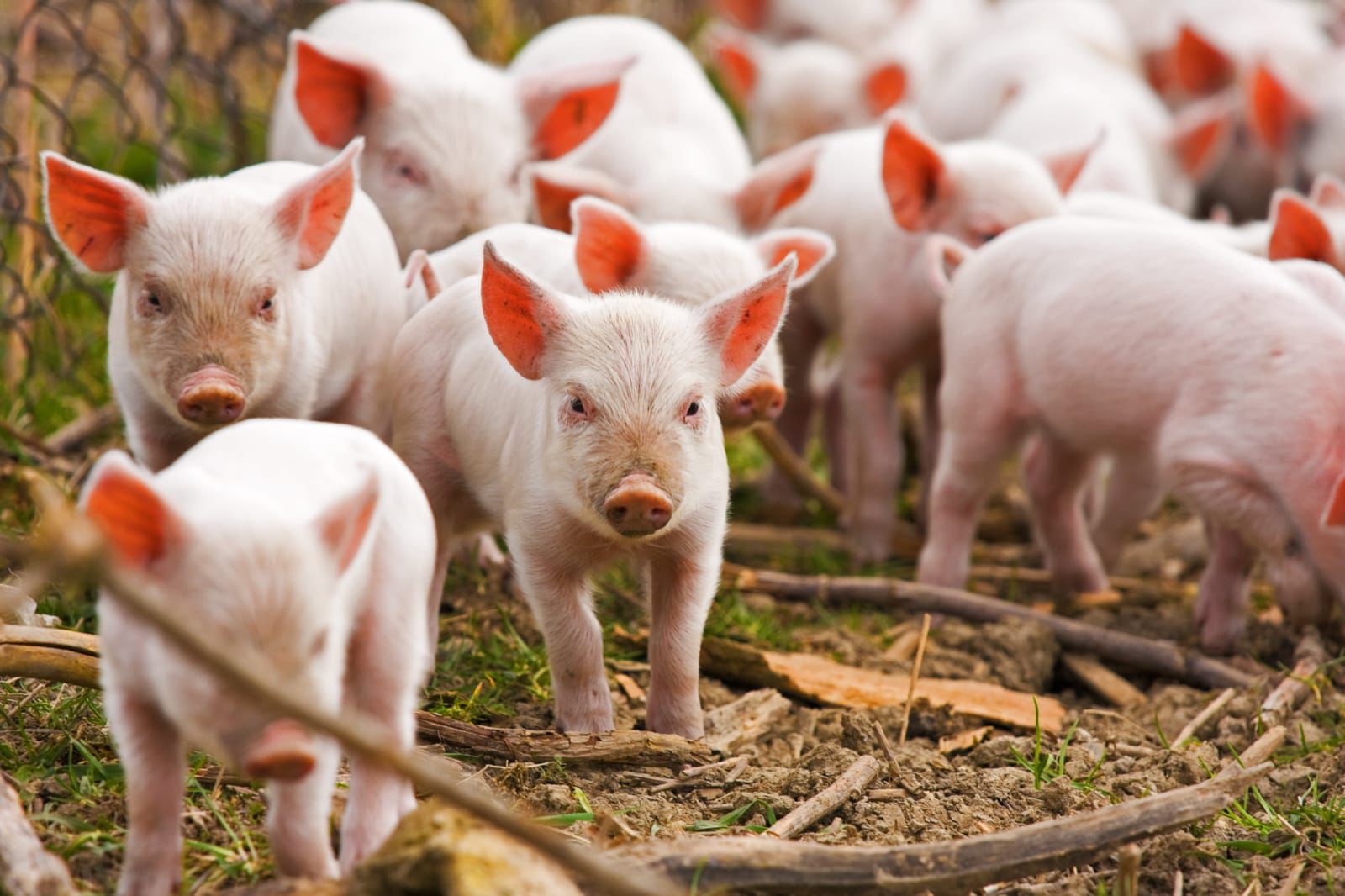
The pigs are fed early. Not for efficiency. For safety.
Across the complex, people work quickly and quietly, moving through routines they know by heart. Someone checks the feeders. Someone else walks the rows, eyes on the animals, listening for anything out of place. Ventilation systems are tested. Power is checked. Water pressure confirmed. Everything that must be done is done fast, before the sky wakes up.
“At our pig farm, the working day would look like any European agricultural facility,” says Sergiy Kasianov. “If not for the background noise: flying drones, explosions, warning sirens.”
Morning is the narrowest window of relative calm. It is when people come in, knowing that later may not be possible.
Work is organized in shifts, carefully calibrated so that only a minimum number of people are present at any one time. One part of the team is always watching something else entirely: military channels, alert systems, reports of shelling nearby. Phones stay close. Decisions are made quickly. If risk increases, staffing is cut back immediately to a critical minimum. Production continues, but people are pulled away.
By evening, the same choreography repeats. Equipment checks. Water and fuel inventories. Backup systems tested. Preparations for night, when shelling almost always intensifies.
“This is not a movie,” Kasianov says. “It is very exhausting everyday life.”
The Novoraiske Pig Complex: Five Kilometers From the River
The farm is not nameless.
It is the Novoraiske pig production complex, located in the village of Novoraiske, roughly five kilometers from the Dnipro River. That distance matters. It places the site well within range of Russian artillery, Molniya-type drones, and multiple launch rocket systems operating from positions across the river.
The current facility was launched in 2023, after Ukrainian forces liberated parts of Kherson Oblast from Russian occupation. It was part of a deliberate effort by KSG Agro to restore livestock farming in a region where agriculture had been hollowed out by occupation, displacement, and destruction.
The complex houses up to 15,000 animals at a time, producing piglets for further growing and supplying pork to domestic Ukrainian markets. In 2025, the site entered a modernization phase, including the introduction of higher-yield breeding stock sourced from Denmark, intended to increase productivity and stabilize supply chains under wartime constraints.
The Novoraiske pig complex is part of a food system designed to function at scale. Its feeding lines, power supply, water systems, breeding cycles, and transport links are integrated into regional supply chains that feed surrounding oblasts. When it operates, it stabilizes prices, supports local markets, and keeps downstream businesses alive. When it is disrupted, the effects travel outward, hitting processors, distributors, and households far beyond the blast radius.
Infrastructure does not announce itself as such. It does its work quietly, until it is damaged or removed. Then everything downstream begins to fail.
That is why this site matters. Not because it is symbolic, but because it is structural.
When the Farm Itself Became the Target
Any illusion that the Novoraiske complex was merely near the war ended in December 2025.
Within a short span of time, the site was struck three times by drones and missiles. The impacts were not scattered. They did not land on nearby roads or open fields. They hit the buildings of the livestock complex itself.
“There are no military facilities here,” Sergiy Kasianov says. “No headquarters. No equipment. No military units. Only animals and everything needed to care for them.”
That distinction matters. The farm does not sit alongside barracks or weapons depots. It does not share infrastructure with military logistics. Its function is singular and visible: food production. The strikes therefore could not be explained away as spillover or navigational error.
The fact that the missiles hit empty buildings was coincidence, not design.
“We were incredibly lucky that some of the premises were not being used at that moment,” Kasianov says. “Three strikes hit empty buildings. But what will happen next time?”
For him, the conclusion became unavoidable. Repetition removed ambiguity.
“We now understand perfectly well that these attacks are not accidental,” he says. “They are part of a plan to deliberately destroy the Ukrainian agricultural sector.”
Since those December strikes, shelling has become a constant condition rather than an escalation. According to farm management, attacks now occur almost daily. Some directly hit production buildings. Others strike nearby fields, roads, or infrastructure essential to keeping the complex operational. Even when structures remain standing, the consequences accumulate.
Work schedules fracture. Access routes become unsafe. Equipment sits idle not because it is broken, but because people cannot reach it without risking their lives. Animals experience stress that affects health and productivity. Staff presence must be recalculated hour by hour.
“Direct destruction is only one layer of the damage,” Kasianov explains. “There is also financial loss, broken technological chains, and constant pressure on people and animals.”
In this way, the attacks do not need to flatten the complex to achieve their effect. Disruption alone is enough. The goal is not just to destroy buildings, but to exhaust the system that depends on them.
That, Kasianov says, is how agriculture becomes a front line.
Jobs Under Fire
The Novoraiske complex is not an outlier. What happens here reflects a wider pattern across southern and central Ukraine, where agriculture has become one of the most heavily damaged civilian sectors of the war.
Since Russia’s full-scale invasion began in 2022, damage to Ukraine’s agricultural sector has exceeded eleven billion dollars, with estimated losses from disrupted production, destroyed equipment, blocked exports, and abandoned land surpassing seventy billion dollars. The heaviest concentration of that damage has been recorded in frontline and near-frontline regions, including Kherson Oblast and neighboring areas. These figures include destroyed storage facilities, stolen or ruined machinery, lost livestock, and the breakdown of production chains that once connected farms to domestic and global markets.
But those numbers only matter because of where they land.
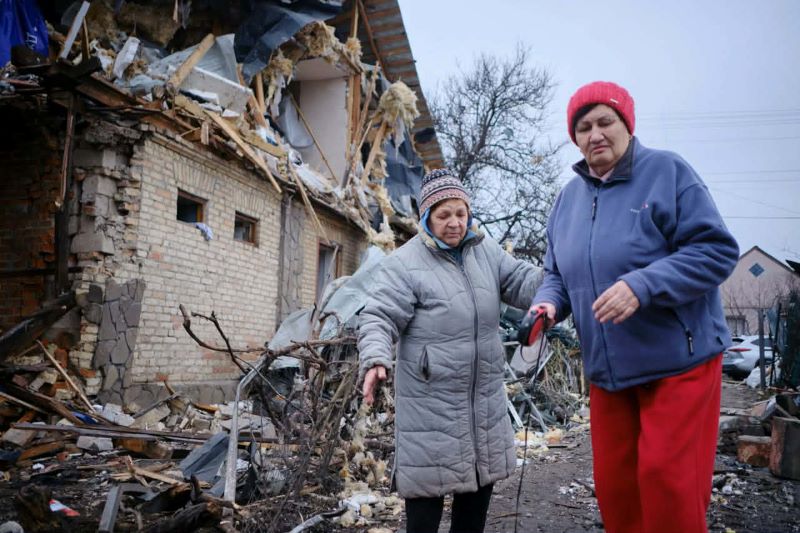
At Novoraiske, around fifty people from the village and nearby settlements work at the pig complex. At its peak, the operation created approximately ninety jobs. Today, only about twenty employees remain permanently on site, with others rotating in as needed to reduce the risk to life.
“For people living in frontline territories, this is not just a place of work,” Kasianov says. “For many, it is survival.”
Employees live within one to three kilometers of the farm. In a region where shelling is routine and businesses have shuttered, the complex is often the only reliable source of income left. There are no parallel industries to absorb workers if it closes. No secondary labor market waiting nearby.
“When there is war outside your window, but someone still pays your salary, it matters,” Kasianov says. “It gives people a reason to stay.”
That decision to stay carries consequences far beyond the farm gates. When a single major employer disappears in a rural frontline area, the collapse is not gradual. Jobs vanish first. Shops close next. Schools follow as families leave. Healthcare thins out, kept alive by overstretched staff and goodwill. What remains is a hollowed-out settlement, emptied not by evacuation orders, but by economic gravity.
This is where the abstraction of economic warfare becomes concrete. The risk here is not theoretical.
A year and a half ago, a car carrying two farm employees was struck by a Russian drone. A woman who worked at the complex was killed. Her husband was seriously injured. They have two children.
“This is a personal tragedy for me,” Kasianov says. “These are not abstract human resources. These are people.”
Attacks do not need to flatten every building to succeed. Repeated shelling forces production slowdowns, limits staffing, and breaks the rhythm agricultural systems depend on. Even when structures remain standing, damage accumulates in lost workdays, stressed animals, interrupted supply chains, and exhausted people.
Survival Is a Strategy, Not a Pause
KSG Agro did not stumble into survival. It reorganized for it.
Early in the full-scale invasion, the company abandoned any model that relied on concentration or stability. In its place, management introduced a network-centric growth strategy, designed to distribute existential, production, financial, organizational, and environmental risks across multiple sites rather than anchoring them to a single vulnerable location.
This shift was not theoretical. In 2022, KSG Agro was among roughly thirteen percent of Ukrainian companies that never stopped operating during the most volatile phase of the invasion. According to management, that continuity drew on hard-earned crisis experience from 2014, when Russia occupied Crimea and parts of Donbas and the company was forced to adapt under pressure.
The holding optimized its 21,000 hectares of land and narrowed its focus to three core areas: grain production for export to Asia and Africa, sunflower processing for European Union markets, and pig farming directed toward domestic food security.
Pig farming became the company’s central wartime business.
Before the full-scale invasion, KSG Agro held a leading position in Ukrainian pig farming, with facilities capable of housing up to 65,000 animals at a time. Today, it ranks among the top five pork producers in Ukraine, supplying regions that include Dnipropetrovsk, Kharkiv, Zaporizhzhia, Kherson, and Mykolaiv, many of them under regular fire.
At the level of the Novoraiske site in Kherson Oblast, however, profitability is not the metric that matters.
“In conditions of daily shelling, any economy is crippled,” Kasianov says.
Downtime is unpredictable. Repairs are constant. Security and logistics costs rise. Animals live under stress. People work under threat. Yet the holding continues to operate the site deliberately, even as margins shrink.
“If after the war you have only walls,” Kasianov says, “that is not survival. That is ruins.”
Survival, as he defines it, is not waiting for the war to end. It is preserving people, skills, production chains, and trust so that recovery does not begin from zero.
This is where the outside world often misreads what is happening in frontline regions.
Many assume nothing meaningful can function until peace arrives. Kasianov rejects that premise outright.
“That is not true,” he says. “You can and should work, if you assess risks correctly and share them.”
What Ukrainian agriculture needs, he argues, is not pity. It needs logistics. Access to ports. Insurance instruments that allow investment to continue. Predictable rules that treat wartime production as partnership, not charity.
“We are not asking for donations,” he says. “We are asking for the opportunity to work.”
Two Realities at Once
The war in Ukraine is not only fought in trenches.
It is fought in barns, fields, grain elevators, and livestock complexes like the one in Novoraiske. It is fought in early mornings and shortened shifts. In decisions about who stays and who goes home. In conversations about livestock numbers interrupted by explosions.
People here live in two realities at once. They take children to school. They run for cover. They return to work.
“This is everyday life,” Kasianov says. “Very hard. But real.”
If there is one thing he wants readers to understand, it is this: Ukraine’s war is also a war on food systems. And those systems are being deliberately targeted.
“We know how to create value even in hell,” he says.
The question is whether the world is willing to let that work continue.
This reporting is based on a direct interview with Sergiy Kasianov and information provided to Truthlytics through CIDEIPS.

