


I was shaking when I said it. I stood up in a press booth at the United Nations General Assembly, just a few yards from Benjamin Netanyahu, looked at the Israeli journalists and Netanyahu supporters packed in around me, and said, “I am Jewish, and to stand behind that man goes against absolutely everything in our faith.” Then I turned around and got out of there as fast as my feet could carry me. I was there with press credentials. I know what a journalist is supposed to do in that room. I also know exactly what I did, and I’m telling you anyway, because what happened inside that hall and a few blocks away afterward became one of the clearest reckonings I have ever had with what being Jewish means to me.
The air was charged long before Netanyahu reached the podium. You could tell immediately what everyone would be talking about that day. People had come prepared to walk out on him; some refused to be in the room at all. One woman in a white hijab waited until he began speaking, then stood and walked directly in front of him on her way out, head held high. My press booth had sat nearly empty for hours, a few stragglers had come and gone, but as Netanyahu’s speech approached it filled with Israeli press and supporters. They talked about Israel having provided the screens we were watching the General Assembly on, then turned their attention to Palestinian media. “Oh, you should’ve seen them,” one of them laughed. I said that I write about the Palestinian movement. Nobody answered. The booth simply went quiet.
When Netanyahu took the stage, I had my headphones on and could still hear the noise around me, the chants from elsewhere in the building and the voices inside my own booth. At some point I let out a “Free Palestine.” My whole body was shaking. I was sitting twenty feet from a man whose rhetoric and policies had come to feel terrifyingly familiar from the history I have spent most of my life studying: dehumanization, collective punishment, the insistence that violence against an entire population is necessary for the survival of another. I have studied the Holocaust and the political culture that preceded it for most of my life. So when I use the comparison I used in that room- when I say I felt as though I were twenty feet from today’s Hitler- I understand the gravity of it.
The speech itself followed a pattern I had heard before. October 7 arrived almost without history before it. Netanyahu spoke about victory as something necessary not only for Israel but for the wider world, while the destruction of Palestine existed largely outside the moral frame of the argument. I listened as long as I could. Then I stood up. I am not unfamiliar with what happens to Jews who publicly reject Zionism, and I didn’t wait around to find out what the people sitting behind me wanted to say.
On my way out, I stopped briefly near the SDG Media Zone, where Big Ocean, the South Korean K-pop group whose members are hard of hearing, was participating in UN programming around accessibility and technology. It was an almost surreal transition: I had just walked out of Netanyahu’s speech with my hands still shaking, and elsewhere in the same building cameras were already pointed toward the next panel, the next photograph, the next piece of programming. History can feel like it is cracking open in one room while somebody five doors down is smiling for a photograph.
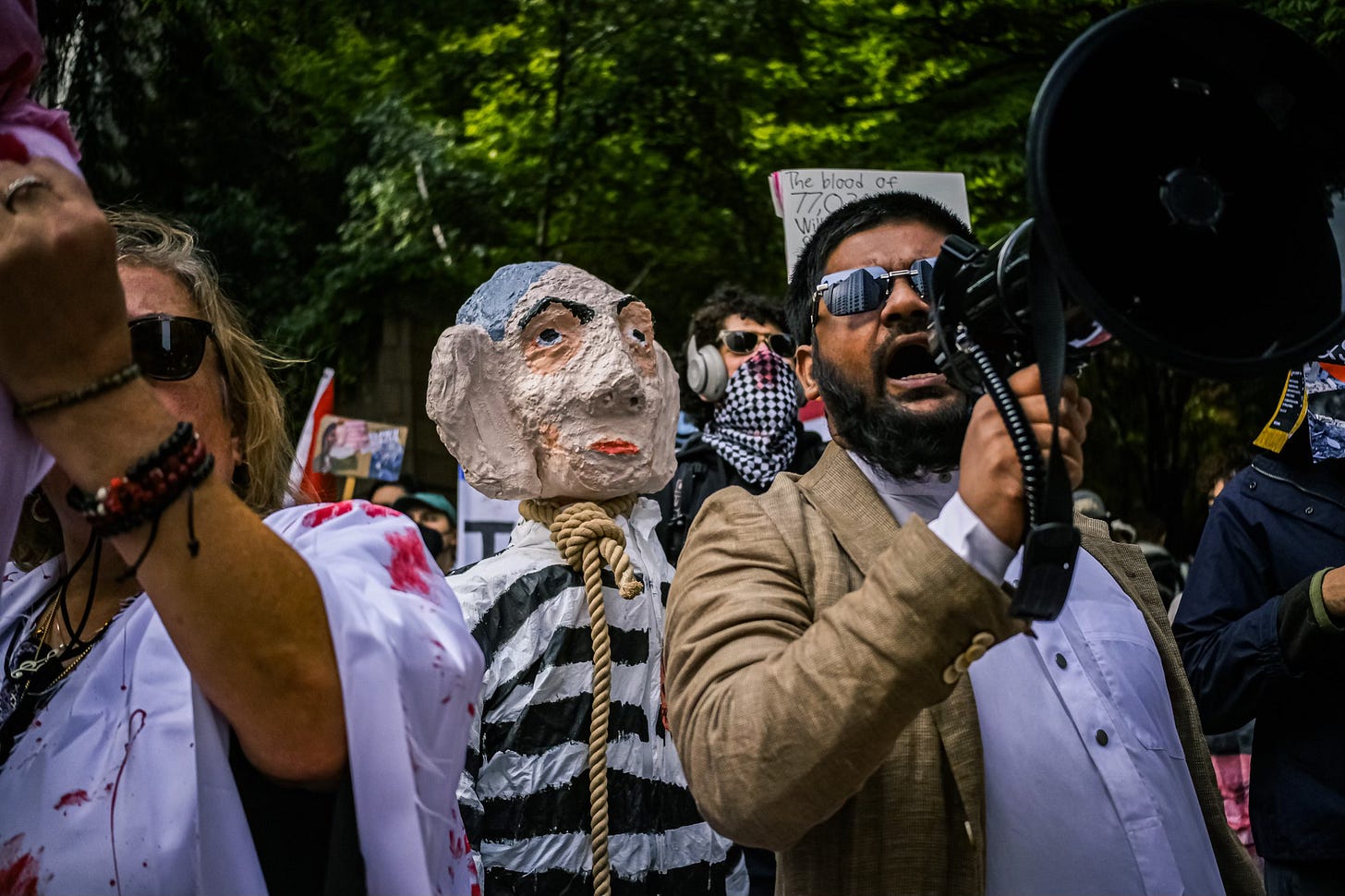
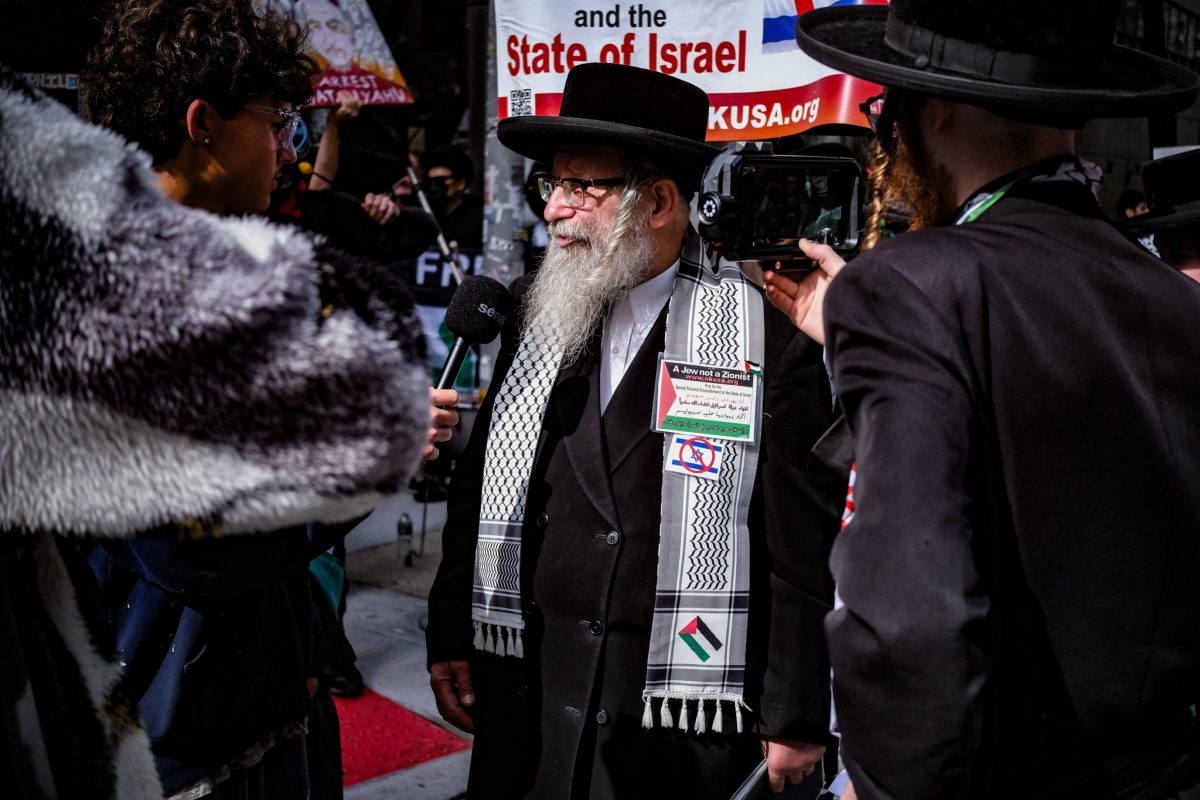
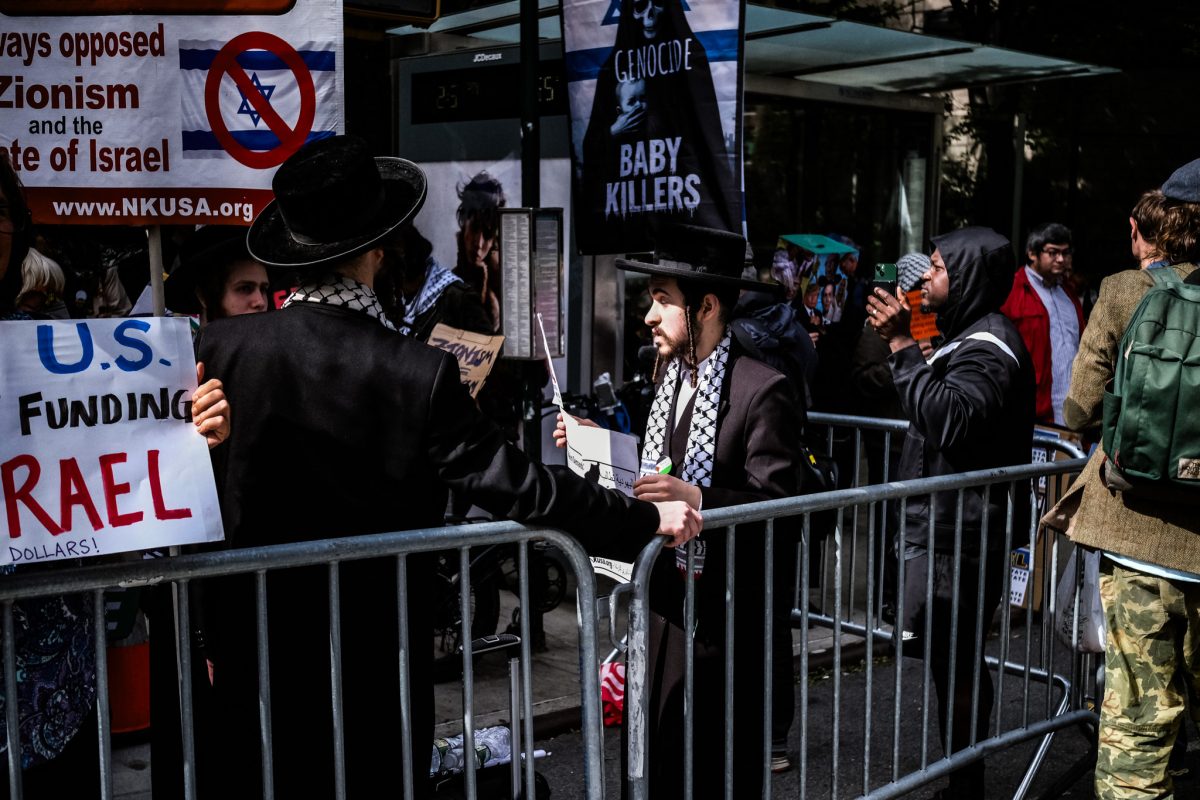
I walked out through the press exit, and two or three blocks from the United Nations I ran directly into the protest. Among the Palestinians, activists and demonstrators were Orthodox Jews. That sight hit me harder than I expected, because I have spent most of my life having to explain why I am Jewish.
I practice Kabbalah now, though I do not attend synagogue. My father is Jewish, and my mother carries Ashkenazi ancestry but practiced Catholicism. Judaism was still the only faith in my home that I knew growing up. It was also woven through the family that helped raise me: a Jewish woman who cared for me through my formative years and her son, whom I babysat, both of whom made me part of their family and still do. It was through them, almost by accident, that I was first introduced to the Shoah. And it was through my father that Judaism became something I understood as my own- the faith we talked about countless times growing up, the faith that shaped how I understood family, history, suffering and responsibility. It was my faith.
The Reform movement formally recognized patrilineal descent before I was born, but that has never stopped people from asking which parent, what synagogue, what practice, what lineage…as if Jewishness were a form I might fill out incorrectly. I have spent a lifetime being asked to explain something that, to me, was never abstract. It was simply who I was.
On my Honeymoon Israel trip, the rabbi accompanying us told me plainly that I was Jewish. I was there as a Jew. When I was invited to the challah bake, when I was included in the rituals and conversations and rhythms of Jewish life without being asked to justify myself first, I felt like I had finally, finally found my community.
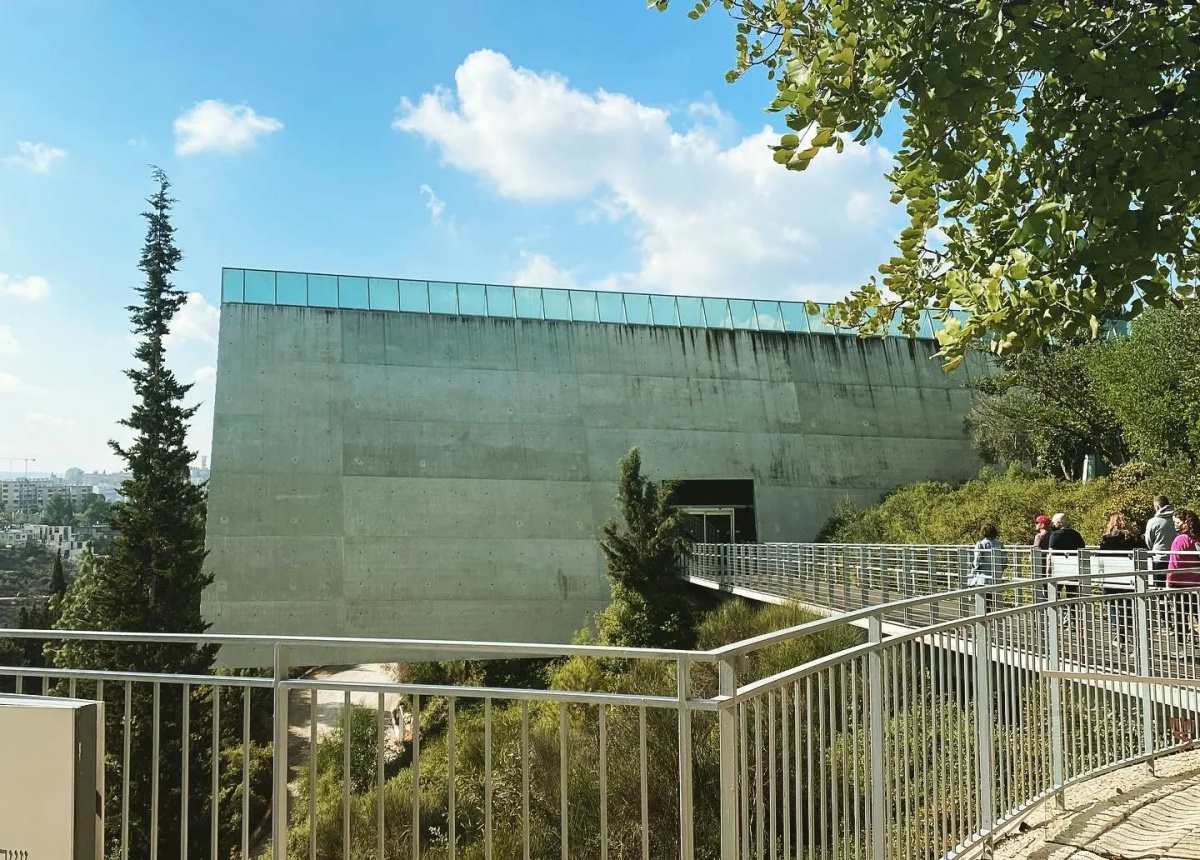
By the time I stood inside Yad Vashem, Israel’s Holocaust remembrance center in Jerusalem, a place I had wanted to visit for years, that feeling had settled into something deeper. I remember thinking about the language Holocaust education had given me since I was young: bystander and upstander. I understood, or thought I understood, what it meant to choose between them. I felt connected not just to a people and a history, but to an obligation that had shaped much of my life. What I did not understand yet was what would happen when the political state claiming to represent that people no longer felt morally aligned with the lessons I believed that history had taught me.
Then October 7 happened, followed by the assault on Palestine. As politicians and commentators repeated Israel’s right to defend itself, something in that language made me uneasy almost immediately.
I grew up in the post-9/11 United States. I know how quickly enormous violence can be placed beneath words like security and defense. Within days, I was finding history I had never seriously confronted. I had been to Israel. I had stood inside military sites. I had looked at fences and accepted the explanation that they were there to keep terrorists out. I had spent years studying what persecution had cost Jews, yet somehow had never seriously asked what the creation and expansion of Israel had cost Palestinians.
Naively, embarrassingly, I had carried some vague understanding that Jewish refugees had found largely unused land and built a country there. It is remarkable what our minds can leave unquestioned when questioning it would destabilize everything else we think we understand.
Once I began pulling at that thread, I found Jewish dissent running through the history too. In December 1948, Albert Einstein, Hannah Arendt and more than two dozen other Jewish intellectuals signed a letter published in The New York Times warning Americans about Menachem Begin and his newly formed Herut party, describing the movement in explicitly fascist terms. Herut eventually became part of Likud, the party Netanyahu now leads.
That destroys the idea that opposition to Zionist politics is something Jews invented after October 7. Jews were arguing about nationalism, Zionism, Palestinian displacement, militarism and what a Jewish state could become while Israel itself was being created.
Months after October 7, I wrote to my own rabbi looking for guidance. I never received a response. We were not particularly active members of the congregation, but it was still my Jewish community, and when everything I thought I understood about Judaism and Israel started coming apart, that was where I went. I reached out for help and heard nothing back.
That was the person who walked up to an Orthodox rabbi on a sidewalk outside the United Nations.
He was with Neturei Karta International, a small ultra-Orthodox anti-Zionist movement. I told him I was Jewish. I told him about my work, where I was from, and how isolating it had been to speak publicly against what was being done to Palestinians. He did not ask which one of my parents was Jewish. He did not ask about my observance or make me prove that I belonged. He simply welcomed me as a fellow Jew and invited me to stay in contact. I thanked him for standing there.
Neturei Karta’s position is rooted in the belief that Judaism and Zionism are not the same thing and, in some respects, are fundamentally at odds. They argue that Jewish law forbids killing, theft and oppression, that Jews were meant to remain in exile until redemption rather than establish sovereignty through force, and that the State of Israel cannot claim to speak for all Jews.
They also argue that the relationship between the Zionist movement, European antisemitism and Nazi Germany has been sanitized in the way much of this history is taught. A few years ago, I would have recoiled at that claim. I don’t anymore. I have now seen enough primary-source material to know that the relationship deserves far more scrutiny than it usually receives, and that questions about collaboration, political calculation, transfer agreements, immigration policy and who benefited from which decisions should not be treated as forbidden simply because they are uncomfortable.
Holocaust history does not become less rigorous when we ask uncomfortable questions about every political actor involved. It becomes more rigorous.
He gave me literature from Neturei Karta International. One pamphlet was titled “Anti-Zionism Is NOT Anti-Semitism.” Another was called “Worldwide Jewish Solidarity with Gaza.” Their argument was explicitly Jewish: that opposing Zionism is not a rejection of Judaism, but for them an expression of it; that Jewish law places obligations on how Jews treat other people; and that no state gets to claim moral immunity simply because it calls itself Jewish.
I did not need a pamphlet to tell me what to think. I am a journalist, and by then I had already spent years following primary documents, reading the record and finding history that raised questions I had never been taught to ask. What mattered was standing on that sidewalk, holding those pages, after spending nearly three years being told explicitly and implicitly that rejecting what Israel was doing somehow placed me outside my own people. Here were Orthodox Jews telling me the opposite: that opposition to Zionism could itself come from Judaism.
The Holocaust taught me the cost of being a bystander. For years, that lesson belonged to history, attached to choices other people had been forced to make before I was born. What no museum can really teach you is what the choice feels like when it becomes yours- when your hands are shaking, when belonging itself suddenly feels conditional. And then, a few blocks away, on a sidewalk full of people demanding that Palestinians be allowed to live, another Jew reminded me that I did not have to surrender my Judaism in order to say so.

