


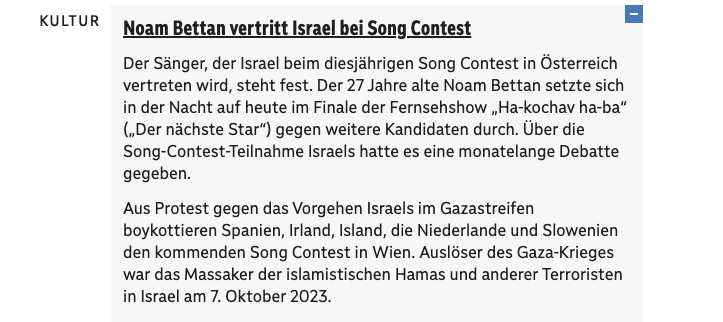
As independent journalism confronts increasing pressures from state-aligned narratives and polarized discourse, the responsibility to identify and challenge media bias has never been more urgent. A recent excerpt from Austria’s public broadcaster ORF.at illustrates how subtle language choices can shape public perception of complex geopolitical events.
“Aus Protest gegen das Vorgehen Israels im Gazastreifen boykottieren Spanien, Irland, Island, die Niederlande und Slowenien den kommenden Song Contest in Wien. Auslöser des Gaza-Krieges war das Massaker der islamistischen Hamas und anderer Terroristen in Israel am 7. Oktober 2023.”
This report centers on a boycott by five European countries of the Eurovision Song Contest, which they frame as a direct response to Israel’s military operations in Gaza. While factually correct, the passage reveals significant framing bias and loaded language that merit closer scrutiny.
Referring to Israel’s actions in Gaza simply as “Vorgehen” (conduct or operation) downplays the scale and severity of the humanitarian crisis — language that risks obscuring what many international experts and human rights organizations have described as a genocide.
Describing the October 7 attack as a “massacre by the Islamist Hamas and other terrorists” employs emotionally charged and ideologically laden language. Although many Western governments classify Hamas as a terrorist organization, the phrase risks precluding nuanced understanding of the broader conflict — particularly when the piece offers no parallel critical framing of Israel’s military response, which resulted in thousands of Palestinian civilian deaths and widespread destruction.
By assigning unilateral blame for the Gaza war to the events of October 7, the article simplifies a deeply complex historical and political conflict. This causal framing erases the decades-long context of occupation, blockade, and contested narratives of statehood and resistance.
Such asymmetry in coverage – highlighting one side’s violence while minimizing or omitting the other’s – contributes to public misperception and erodes trust in journalism.
At Truthlytics, we advocate for journalism that resists oversimplification. We call on public broadcasters, especially those funded by taxpayers, to uphold the principles of neutrality, historical context, and ethical responsibility. In a time of humanitarian crisis and escalating polarization, words matter — and so does the way they are used.

